 Aleksandra P. Buzhilova1,*, Mikhail V. Shunkov2,**, Lin Guo1,*** and Maxim B. Kozlikin2,****
1Research Institute and Museum of Anthropology, Moscow Lomonosov State University, Moscow, Russia
2Institute of Archaeology and Ethnography SB RAS, Novosibirsk, Russia
*E-mail: albu_pa@mail.ru
**E-mail: shunkov77@gmail.com
***E-mail: 904621462@qq.com
****E-mail: kmb777@yandex.ru
Keywords: Altai, Denisova Cave, East Asia, Pleistocene, odontology, paleoanthropology, Denisovans, micro-CT.
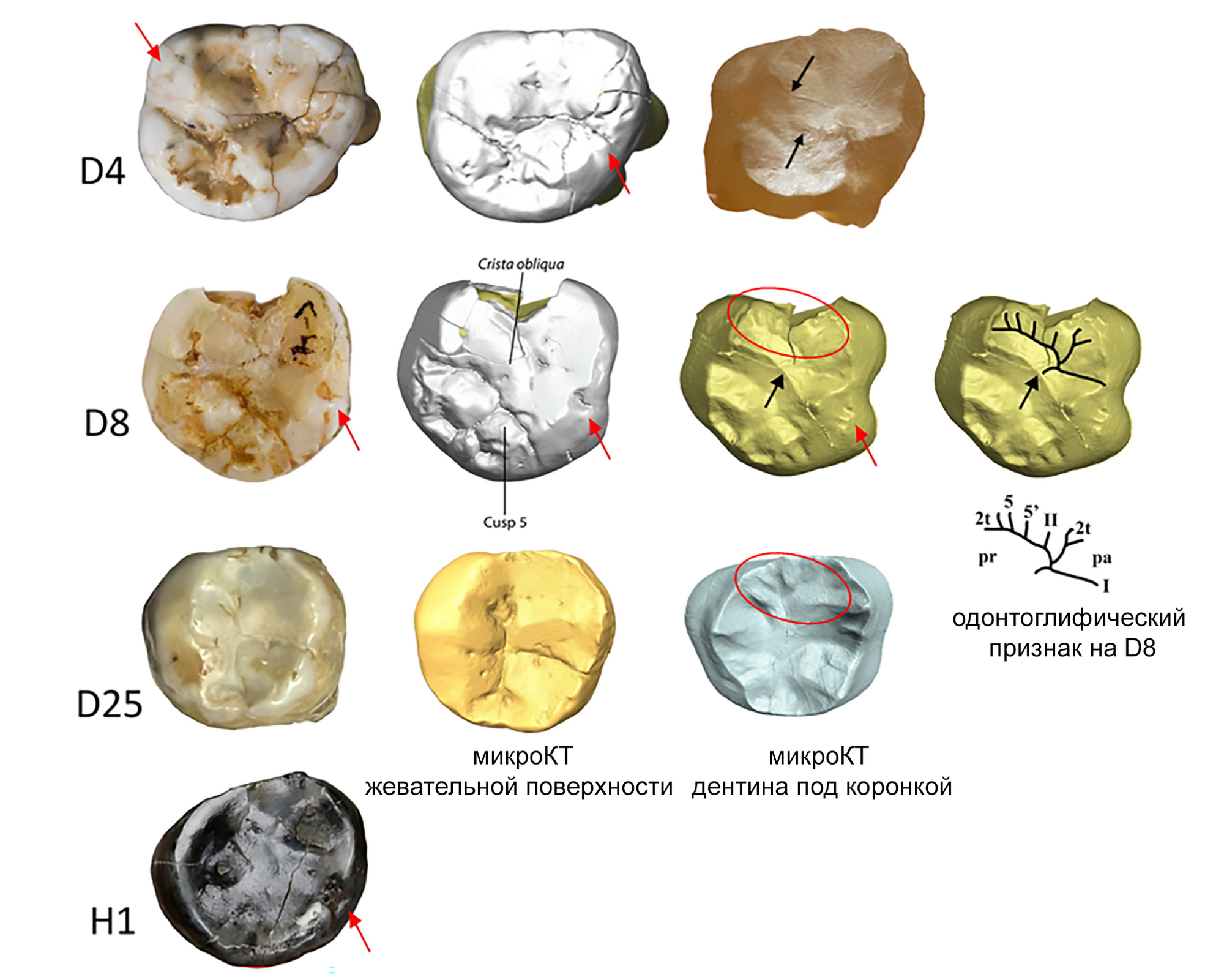
The article presents an analytical review of Denisovan remains and contemporaneous anthropological finds from the second half to the mid-first half of the Upper Pleistocene discovered in eastern Eurasia. Chronological data indicate that the peak of Denisovan activity in geographically diverse mountainous landscapes occurred between 160 and 150 kya. Faunal assemblages from the Denisova, Baishiya, and Tam Ngu Hao caves reflect the landscape and climatic conditions of mountainous, high-latitude, and tropical or subtropical environments, which confirms the ecological flexibility of Denisovans. The development of morphological and genetic adaptations to these living conditions cannot be ruled out. Analysis of molars suggests that Denisovans occupy an intermediate position between Middle Pleistocene West European hominins and Asian H. erectus. Some individuals from the Chinese sites of Xujiayao and Hexian demonstrate the greatest similarity to Altai Denisovans. Related forms include finds from Chaoxian, Jinniushan, and Hualongdong in China. The skulls of the archaic hominin Dali and the Rhodesian Kabwe 1 are similar to the Denisovan from Harbin. Their characteristics are similar to those described by geneticists for Denisovans. The relative similarity of the Harbin and Xuchang 1 skulls, as well as the Dali and Jinniushan skulls, expands the range of potential Denisovans. The Denisovan habitat identified based on anthropological findings reveals a characteristic “compact” pattern – a predominantly mountainous landscape in eastern China during the second half of the Middle Pleistocene. Skulls from Harbin, Dali, and Jinniushan, a mandible from Penghu, and skeletal bones from Jinniushan are characterized by a distinctly massive build. Postcranial remains from Jinniushan reveal specific skeletal proportions suggesting genetic adaptation to low temperatures. This complex of specific features may be related to the consequences of local adaptation to environmental conditions during migration along the so-called northern route.
DOI: 10.7868/S3034577426030012