Valentina N. Kuznetsova1,* and Vladislav Yu. Sobolev2,**
1Institute for the History of Material Culture RAS, St. Petersburg, Russia
2Saint Petersburg State University, St. Petersburg, Russia
*E-mail: valentkuznets@mail.ru
**E-mail: vlad.sobolev@gmail.com
Keywords: Rus, pendants, trinkets, adornments, amulets, symbols.
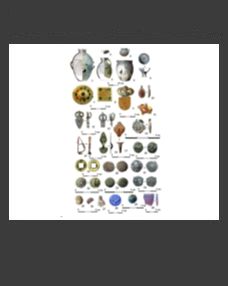
This article examines composite pendants that were part of women’s attire in the 12th–13th centuries AD. They were complex adornments comprising a “base” – an arched chain-holder, a wire ring or another object holding a composition together, a chain, or a ribbon/strap to which small pendants were attached – zoomorphic ones, or shaped as everyday objects, bells, drilled teeth of predators, and sometimes objects of personal devotion. In the second half of the 20th century, researchers regarded such finds as magical amulets and evidence of the remnants of paganism in Rus. The authors of this article assume that the sets of “amulets” were objects of personal devotion rather than attributes of pagan cults. It is worth noting the similarity of the zoomorphic images with art pieces of Christian culture (book miniatures, architectural carvings, etc.). The pendants shaped as miniature household objects are similar to attributes of saints and elements of church decoration and liturgy.
DOI: 10.7868/S3034577426020070